
Table of Contents
Additive manufacturing, commonly referred to as 3D printing, has become a game-changing technology in the manufacturing industry, providing previously unheard-of capabilities for creating intricate products and parts. 3D printing is changing conventional manufacturing methods, spurring innovation, and opening up new opportunities in a variety of industries by layering objects from digital models. This article examines how 3D printing is transforming the manufacturing industry, stressing its main benefits, uses, and prospects.
1. Advantages of 3D Printing in Manufacturing
1.1. Rapid Prototyping and Development
The ability of 3D printing to speed up the development and prototyping process is one of its biggest benefits. Conventional manufacturing techniques frequently call for the development of physical molds and tooling, as well as drawn-out and expensive prototyping cycles. By enabling designers to quickly create and test prototypes without the need for costly tooling, 3D printing, on the other hand, facilitates rapid iteration.
Prototyping’s agility and speed result in shorter design cycles, lower development costs, and quicker product launches. For instance, 3D printing is used by businesses in the automotive and aerospace sectors to create and test new parts, spurring innovation and enhancing product performance.
1.2. Customization and Personalization
3D printing is excellent at creating unique, tailored products that satisfy each customer’s needs and preferences. 3D printing makes it possible to create custom items at a significantly lower cost than traditional manufacturing, which frequently entails mass production.
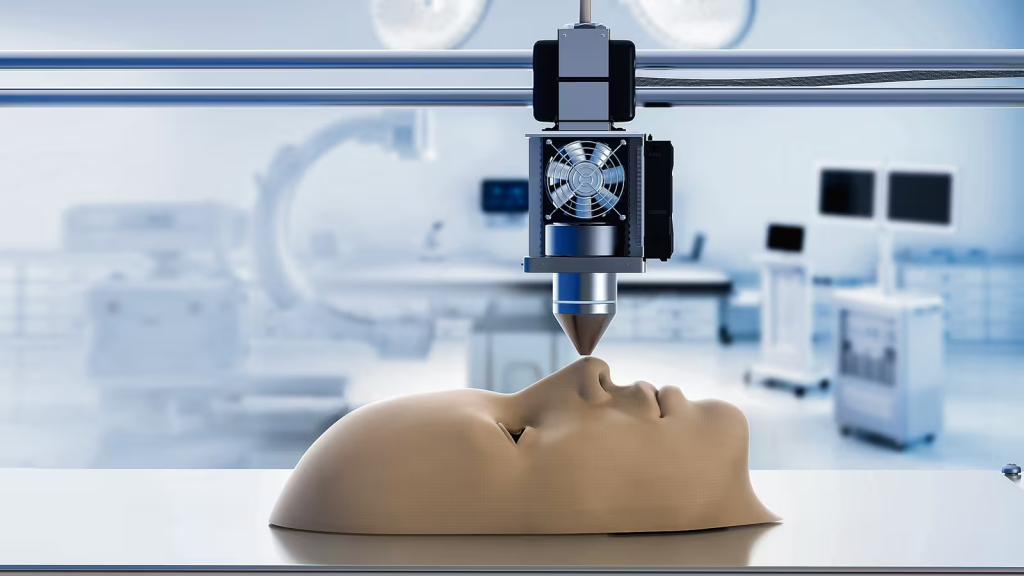
This ability is especially useful in sectors like healthcare, where patients can have their own personalized implants, prosthetics, and medical devices. For example, users’ quality of life can be enhanced by precisely and comfortably fitting prosthetic limbs made using 3D printing.
1.3. Complex Geometries and Lightweight Structures
Traditional manufacturing methods often struggle with producing complex geometries and intricate designs due to limitations in tooling and machining. 3D printing, however, enables the creation of complex shapes and structures that would be challenging or impossible to achieve with conventional methods.
This capability is especially advantageous in industries such as aerospace and automotive, where lightweight and high-performance components are crucial. 3D printing allows for the production of lattice structures, internal cavities, and optimized geometries that reduce weight while maintaining strength and functionality.
1.4. Reduced Waste and Sustainability
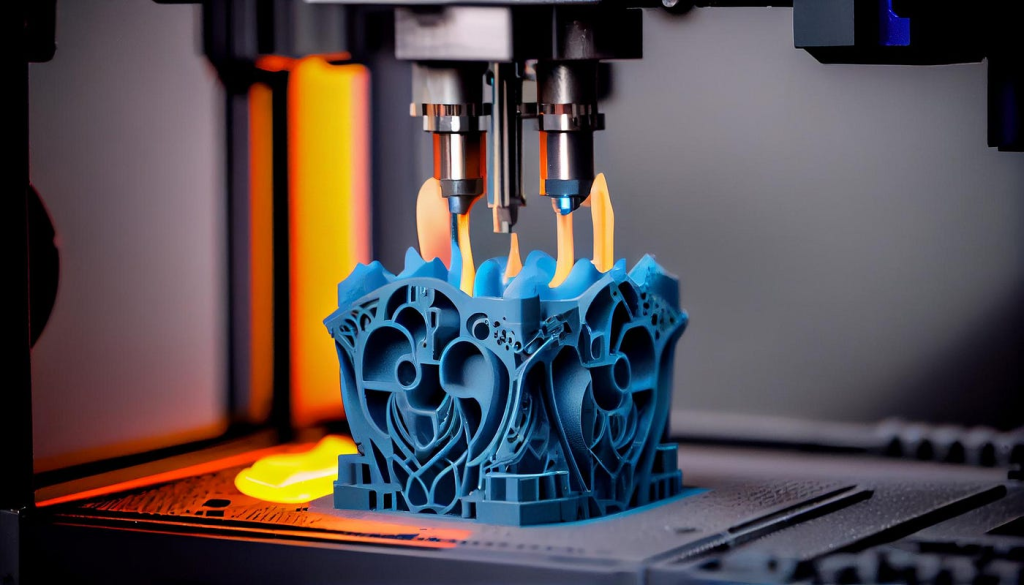
Compared to traditional subtractive manufacturing techniques, which involve removing material from a larger block and frequently result in significant waste, 3D printing is intrinsically more sustainable. 3D printing, on the other hand, uses only the amount of material required to create the finished product, adding it layer by layer.
In addition to lowering costs, this decrease in material waste supports more environmentally friendly production methods. Further aiding sustainability initiatives, 3D printing also makes on-demand production possible, which minimizes overproduction and eliminates the need for huge inventories.
2. Applications Across Industries
2.1. Aerospace and Defense
3D printing is transforming the manufacturing of high-performance parts and components in the defense and aerospace sectors. For aircraft and spacecraft, where weight reduction is essential for performance and fuel efficiency, the ability to design lightweight and complex geometries is especially beneficial.
3D printing is used by companies like Lockheed Martin and Boeing to create structural elements, fuel nozzles, and turbine blades. Additionally, this technology speeds up the development of sophisticated aerospace systems by facilitating the quick prototyping and testing of new designs.
2.2. Automotive
The automotive industry is leveraging 3D printing for both prototyping and production. Automakers use 3D printing to create prototype parts for testing and validation, allowing for faster design iterations and reduced development times.
3D printing is also being used for on-demand production of spare parts and customization of vehicle components. For example, BMW has implemented 3D printing to produce low-volume, customized parts for its vehicles, improving efficiency and reducing inventory costs.
2.3. Healthcare
3D printing is revolutionizing the manufacturing of implants, prosthetics, and medical devices in the healthcare industry. A better fit and increased functionality are guaranteed by the capacity to design implants and prosthetics specifically for each patient.
Surgeons can practice intricate procedures on precise models of patients’ anatomy by using 3D printing to create anatomical models for surgical planning and training. In medical procedures and treatments, this technology improves accuracy and results.
2.4. Consumer Goods
3D printing is being investigated by the consumer goods sector to create limited-edition and customized goods. 3D printing is being used by businesses in the jewelry, fashion, and home décor industries to produce one-of-a-kind designs and customized goods that suit individual tastes.
For example, 3D-printed shoes enable personalized fittings and designs, giving customers specialized items that improve comfort and style. In a similar vein, 3D-printed home décor products provide a degree of customization and originality that is difficult to accomplish with conventional manufacturing techniques.
3. Future Potential and Challenges
3.1. Future Potential
With continuous improvements in materials, technologies, and applications, 3D printing has enormous potential for the future. There is potential for revolutionary advancements in healthcare in emerging fields like bio-printing, which involves printing living tissues and organs for therapeutic use.
Furthermore, combining 3D printing with other technologies like robotics and artificial intelligence (AI) may improve manufacturing efficiency and capabilities even more. 3D printing has the potential to revolutionize supply chains, business models, customer experiences, and manufacturing processes as it develops further.
3.2. Challenges
Notwithstanding its benefits, 3D printing has issues that must be resolved. These include slower production speeds in comparison to conventional methods for high-volume manufacturing, limitations in the selection of materials, and build size restrictions.
Furthermore, as 3D printing technology spreads, regulatory issues and intellectual property issues need to be handled. Maintaining industry standards and customer trust also depends on making sure 3D-printed products are consistent in quality.
Conclusion
Because it allows for complex geometries, rapid prototyping, customization, and decreased waste, 3D printing is completely changing the manufacturing sector. Applications in a wide range of industries, such as consumer goods, healthcare, automotive, and aerospace, show its impact and adaptability. Although there are still obstacles to overcome, the continuous developments in 3D printing technology have enormous potential to revolutionize production methods, spur innovation, and influence the course of the future. Its role in transforming manufacturing will surely grow as this technology develops further, opening up new avenues for growth in a variety of sectors.